Last Updated: 7 May 2026

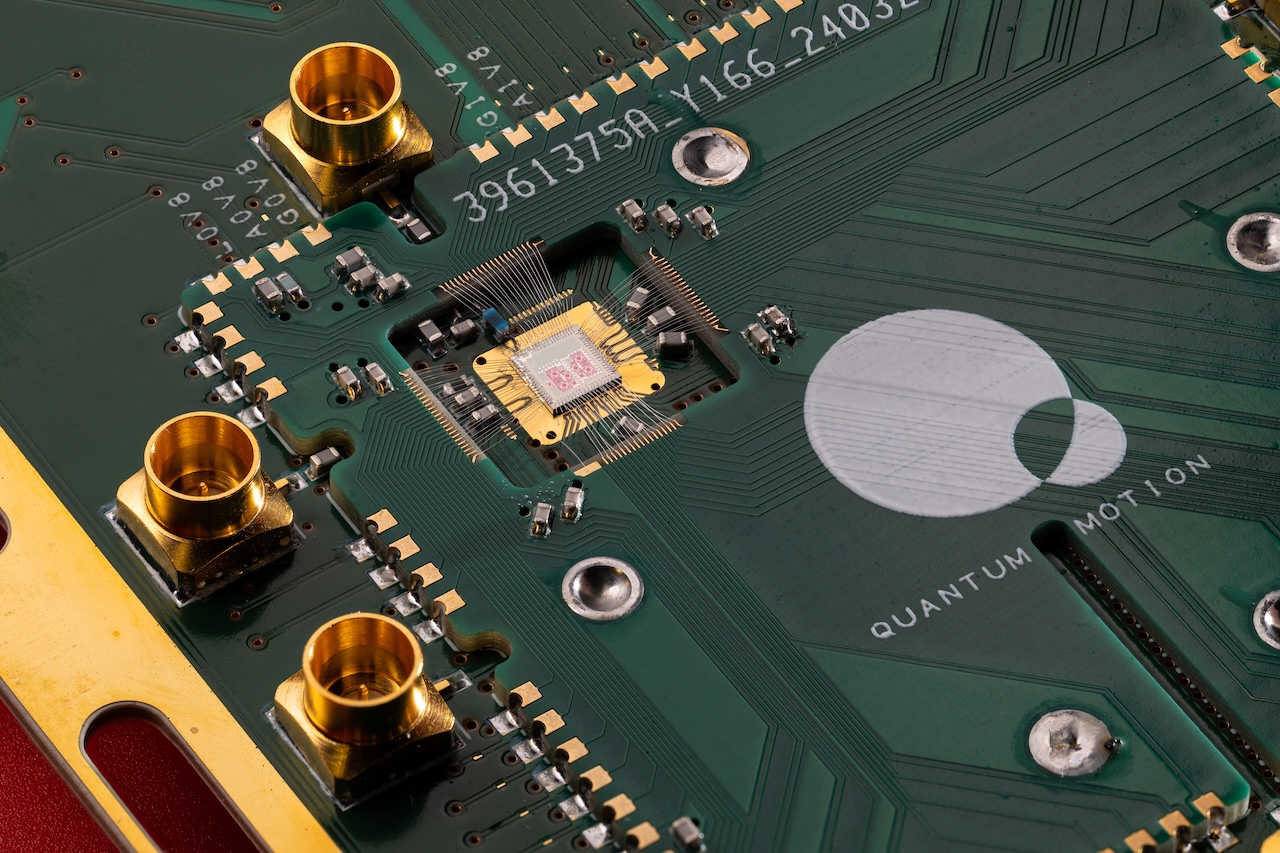
Quantum Motion, a UK company that builds quantum computers using standard silicon transistor technology, has raised $160 million in a Series C funding round. The company, led by CEO Dr. James Palles-Dimmock and co-founded by Dr. John Morton and Dr. Simon Benjamin, is betting that silicon — the same material used in every smartphone and laptop chip — is the strongest foundation for quantum computers that can be built at commercial scale.
Most quantum computing approaches require highly specialised infrastructure: cooling systems that operate near absolute zero, power supplies in the multi-megawatt range, and purpose-built facilities unlike anything in a standard data centre. That is already a costly proposition. Global data centre electricity consumption reached around 415 TWh in 2024 and is projected to nearly double by 2030, with AI workloads driving much of that growth. Piling a second wave of energy-intensive computing onto already strained power grids is, at minimum, an expensive problem. Quantum Motion's position is that a different path exists.
The $160 million round was co-led by DCVC and Kembara, with the British Business Bank and Firgun joining as new investors alongside returning backers. The raise makes Quantum Motion the best-funded quantum computing company in the UK.
Quantum Motion's main claim is that its approach costs far less to build and run than competing architectures. The company says its silicon CMOS systems deliver a 100-fold reduction in cost and space requirements and a 1,000-fold reduction in energy consumption compared to alternatives. Part of what drives those numbers is cooling. Research published by IEEE shows that in many quantum systems, the energy required to cool the hardware to operating temperature far exceeds the energy the computer itself consumes, and that this overhead varies significantly depending on the architecture chosen. Silicon-based designs sidestep much of that burden.
Most companies in the quantum computing space have focused on demonstrating high qubit counts in laboratory conditions. Quantum Motion has instead prioritised manufacturability. In 2025, it delivered what it describes as the world's first commercial deployment of a full-stack silicon CMOS quantum computer, installed at the UK National Quantum Computing Centre. The company has also progressed to Stage B of DARPA's Quantum Benchmarking Initiative, a US defence research programme that measures real-world quantum performance.
"Quantum is critical infrastructure for the next century of computing, AI, and security, and leadership will go to whoever can industrialise it. DCVC led this investment in Quantum Motion because silicon is the foundation that scales, and this team is building on the CMOS advantage to turn quantum from a demonstration into a commercial success story."
Dr. Prineha Narang, Operating Partner at DCVC
The new capital will go toward commercialising Quantum Motion's technology and advancing its roadmap to utility-scale systems. Since its previous funding round in 2023, the company has opened offices and labs in Spain and Australia and expanded its manufacturing partnership with GlobalFoundries, one of the world's largest contract chip manufacturers. That relationship connects Quantum Motion's production timeline directly to established semiconductor supply chains, rather than requiring the company to develop its own fabrication processes from scratch.
The end goal is a quantum computer that slots into a standard data centre rack, with no specialist facilities and no unusual power requirements. Quantum Motion is targeting organisations that already spend heavily on high-performance computing — in sectors like finance, pharmaceuticals, defence, and materials science — and want access to quantum capability without redesigning their infrastructure.
"Today's announcement reflects the strength of the team we have built and the progress they have delivered. Quantum computing will only achieve its full potential if it can be built on a platform that scales, and we believe silicon is the strongest route to achieving that. We are pleased to be joined by investors who share our vision and understand what it takes to build a foundational company in this field."
Dr. James Palles-Dimmock, CEO of Quantum Motion
Quantum Motion was founded by Dr. John Morton, now CTO, and Dr. Simon Benjamin, now CSO. Both have research backgrounds in quantum physics and silicon device engineering. The company has offices and labs in London, Oxford, San Sebastian, and Sydney.
The core idea behind the company's technology is that silicon manufacturing has already solved the hardest part of scaling. Billions of transistors now fit on a chip the size of a postage stamp, the result of decades of investment in semiconductor production. Quantum Motion applies those same industrial processes to qubits — the basic units of a quantum computer.
A qubit works differently from a classical bit. A standard computer bit is always either 0 or 1. A qubit can exist in both states at once, a property that allows quantum computers to perform certain calculations that would take classical machines an impractical amount of time. The practical challenge is manufacturing enough reliable qubits at a reasonable cost. Most current approaches need each qubit kept in an extremely cold, custom-built environment. Quantum Motion's qubits are made through the same foundry processes used for consumer electronics, which makes large-scale production feasible.
"As founders we were inspired by the breathtaking accomplishments of silicon technology, with city-like complexity delivered on centimetre scale chips. Now, Quantum Motion's chips can be used not only for bits but also for qubits, unlocking a future in which quantum computers are both fast and ubiquitous."
Dr. John Morton, CTO, and Dr. Simon Benjamin, CSO, Quantum Motion
The round was co-led by DCVC, a deep tech venture firm, and Kembara, a technology-focused investor. The British Business Bank and Firgun joined as new participants. Returning investors include Oxford Science Enterprises, Inkef, Bosch Ventures, Porsche Automobil Holding SE, and Parkwalk Advisors.
"If you believe quantum computing is going to be world-changing, as we do, then the obvious next question is which of the many ways of building one will actually work at scale? This investment signals our strong belief in where the answer lies."
Yann de Vries, Partner and co-founder of Kembara