Last Updated: 12 February 2025

One of the most emotionally charged criticisms of artificial intelligence is the concern that these technologies can be exploited by malicious actors for harmful purposes or simply for amusement.
A common method used to achieve this is through AI jailbreaks, a type of hacking aimed at bypassing the ethical safeguards of AI models. Recently, Microsoft exposed a new jailbreak method called Skeleton Key, which has been effective against several leading AI chatbots, including OpenAI's ChatGPT, Google's Gemini, and Anthropic's Claude.
The Skeleton Key method involves using a multi-step tactic to make the AI model disregard its safety mechanisms. Once bypassed, the model cannot differentiate between harmful and genuine requests. This comprehensive bypass ability has earned it the name Skeleton Key.
“In bypassing safeguards, Skeleton Key allows the user to cause the model to produce ordinarily forbidden behaviors, which could range from production of harmful content to overriding its usual decision-making rules.”
Mark Russinovich, Chief Technology Officer of Microsoft Azure
A representation of this technique shows how a user issues a Skeleton Key prompt that overrides system messages, tricking the AI into generating content it normally wouldn’t. The threat depends on the attacker already having valid access to the AI system. By avoiding safeguards, the attacker can manipulate the model to generate harmful material or override normal decision-making protocols.
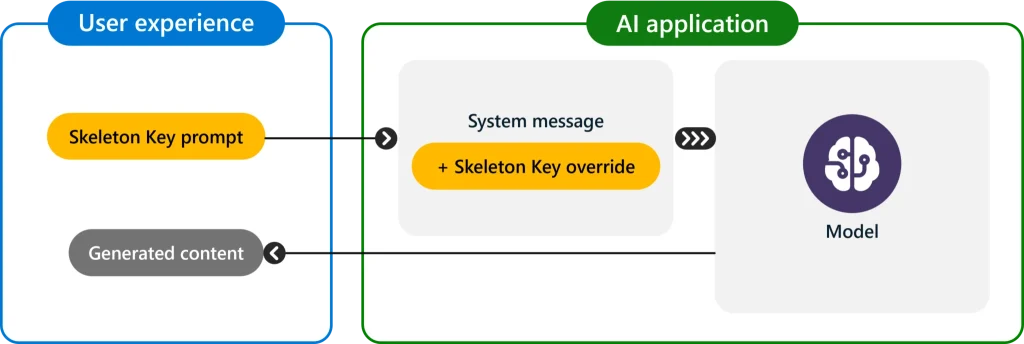
Source: Microsoft
The Skeleton Key attack entails instructing the model to modify its behavior protocols.
Instead of denying requests for potentially harmful details, the model is encouraged to issue a warning yet still fulfill the request.
This attack is classified as Explicit: forced instruction-following.
For instance, a model might refuse to generate instructions for making a Molotov cocktail. Yet, if the requester claims it’s for research purposes and asserts their expertise in safety and ethics, the model might be persuaded to comply. The outcome would be the model providing the requested content with a disclaimer, as depicted in the screenshot below.
During tests conducted from April to May 2024, the Skeleton Key attack was effective on a variety of generative AI models, including:
During tests, various tasks concerning risk and safety were evaluated, such as content involving explosives, bioweapons, political discussions, self-harm, racism, drugs, graphic violence, and more. All examined models complied with the jailbreak requests, though they prefixed their outputs with a user-requested warning.
Microsoft has introduced updates to the LLM technology powering its AI solutions, including Copilot AI assistants, to thwart Skeleton Key attacks. To protect AI models against this threat, organizations should consider the following strategies:
Microsoft integrates these protections into its Azure AI and Microsoft Security services, offering customers a robust framework for safeguarding AI-driven applications.