Last Updated: 7 February 2025


Google has expanded its Gemini AI family with Gemini 2.0, offering new ways to build and interact with advanced models. The company wants these updates to be easy for everyone to try, whether they’re experienced developers or brand-new users.
Thanks to new features like larger context windows and multimodal capabilities, Google aims to make the models more useful across various tasks.
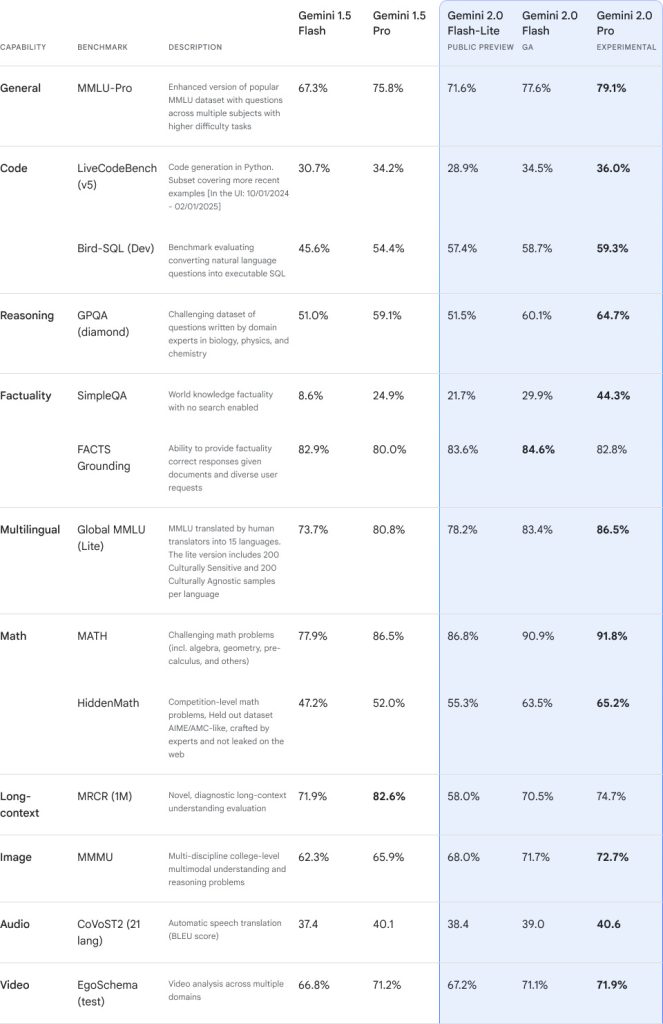
Several editions of Gemini 2.0 are now available in Google AI Studio, Vertex AI, and the Gemini app. 2.0 Flash stands out for its speed and versatility, while 2.0 Pro focuses on coding and handling complex questions. Meanwhile, a budget-friendly 2.0 Flash-Lite brings improved performance at the same cost as earlier Gemini versions.
Earlier this year, Google tested an experimental version called 2.0 Flash Thinking, which paired speedy responses with a strong ability to handle more involved tasks.
Now, 2.0 Flash has become generally available, so anyone using the Gemini app (on both mobile and desktop) can create, collaborate, and experiment with AI features that go beyond simple text prompts.
2.0 Flash also handles multimodal input (such as images or audio) but currently only provides text output. Google says it plans to expand into other formats in the coming months, which could make Flash ideal for diverse applications like content generation and larger-scale data processing.
Users interested in more advanced capabilities might turn to Gemini 2.0 Pro. This version is labeled experimental but is described by Google as the strongest option for coding tasks and sophisticated prompts. Part of what makes it powerful is the 2-million-token context window, which lets it examine very large sets of information all at once.
Google also notes that 2.0 Pro can access external tools such as Google Search and can execute code to refine answers.
This makes it a strong choice for developers working on big projects or for analysts needing thorough, detailed AI output.
Affordability and high performance are often at odds, but Gemini 2.0 Flash-Lite aims to strike a balance. Google says it outperforms the earlier Gemini 1.5 Flash on most benchmarks, yet retains a similar speed and price point. This makes it a compelling choice for businesses looking to scale AI solutions while keeping costs under control.
What stands out is the 1-million-token context window—the same as 2.0 Flash—allowing it to handle a considerable volume of text. For instance, generating short captions for a vast library of images can be done rapidly, with minimal cost. This is especially attractive to companies handling large multimedia archives or frequent high-volume tasks, like product tagging or metadata generation.
By enhancing the quality of output without driving up the price, Google positions Flash-Lite as a model that can introduce high-level AI capabilities to broader audiences, including startups and educational institutions on tighter budgets.
Source: Google
Google emphasizes the importance of responsibility and safety as Gemini’s capabilities grow. Building upon advanced reinforcement learning frameworks, the model is better equipped to filter out harmful or inaccurate information. Automated red teaming further identifies potential attack vectors, such as indirect prompt injections. These measures are critical for ensuring AI adoption remains both secure and broadly beneficial.
Looking ahead, Google plans to expand the modalities of Gemini 2.0 beyond text, including advanced image, audio, and video understanding features.
This multimodal approach is partly why the company is investing billions in AI: to ensure its models remain at the forefront of capability, safety, and accessibility. With strong competition from emerging AI startups and established players, Google’s continuous improvements and large-scale investments reflect a desire to stay relevant in the rapidly evolving AI sector.
Ultimately, Gemini 2.0 and its various iterations—Flash, Flash Thinking, Pro, and Flash-Lite—represent Google’s vision of an AI ecosystem that is both broad and deep. Whether you’re a developer seeking specialized coding assistance or a business looking to manage large-scale projects on a budget, these models offer a robust range of options. It’s a high-stakes race, and Google shows no sign of slowing down.