Last Updated: 26 August 2026

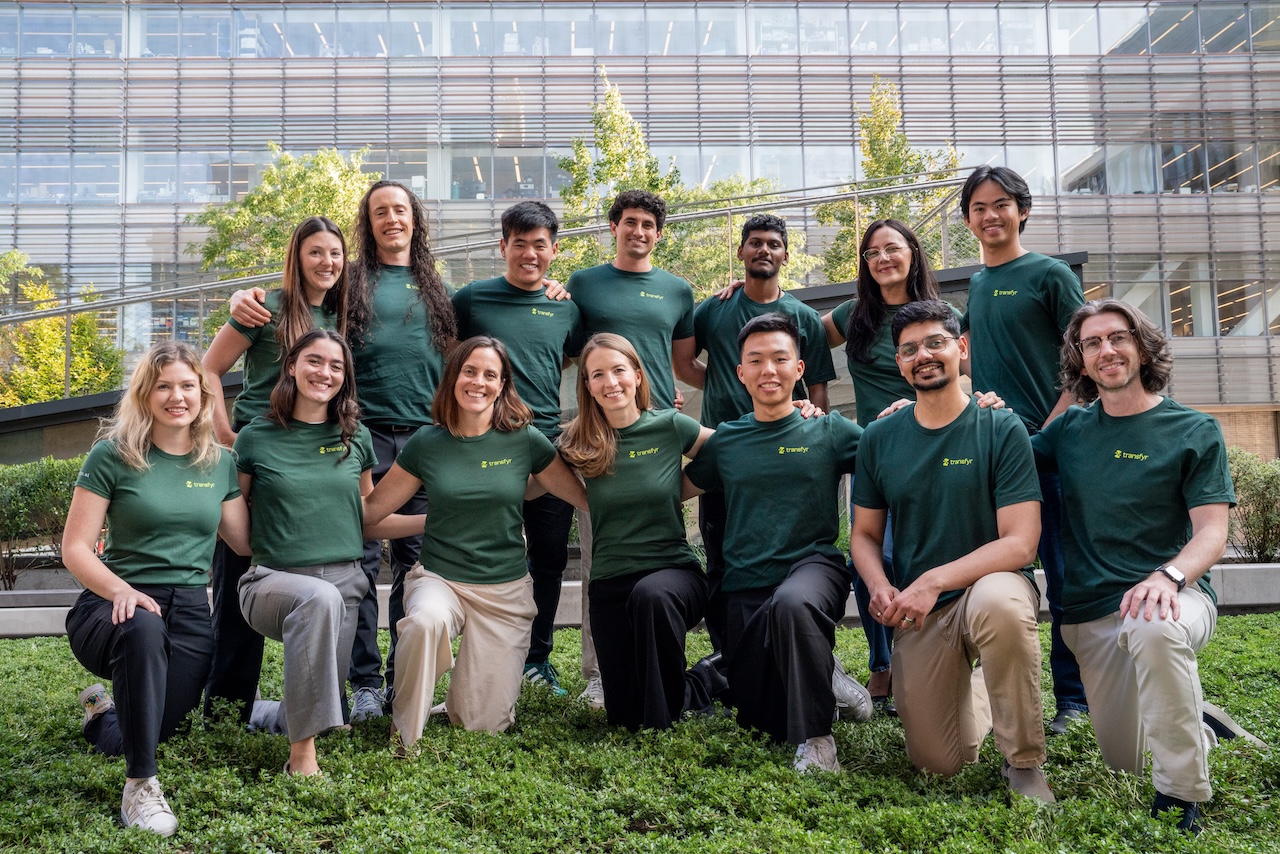
Transfyr, a Cambridge, Massachusetts startup, wants to solve a problem that has cost the science world billions of dollars: too much of what happens in a lab never gets written down. The company believes the real obstacle to scientific progress isn't a shortage of good ideas, but a shortage of usable data about how those ideas get carried out at the bench. It was founded by Anna Marie Wagner, who previously led AI and Corporate Development at Ginkgo Bioworks, and Dr. Renee Wegrzyn, the founding Director of ARPA-H, to close that gap.
That gap carries a real financial cost. According to a recent Accenture report, 64% of drug-launch delays in 2024 were tied to chemistry, manufacturing, and controls, often shortened to CMC, the technical processes behind making a drug safely and consistently. Transfyr's founders point to tech transfer, moving a method from one lab or team to another, as a major piece of that problem. As labs lean more on automation and robotics, storing knowledge in people's heads instead of in data is becoming harder to ignore.
Transfyr launched with $25 million in seed funding. General Catalyst led the round, joined by Lux Capital, Breakout Ventures, Factory, Neo, SV Angel, MVP Ventures, Underscore VC, Lyda Hill, and several angel investors.
Handing off a scientific protocol from one lab, team, or company to another has always leaned heavily on apprenticeship. Successful handoffs can take months of training, troubleshooting, and validation, and even then, many still fail. The tiny fix a scientist makes when a step in a protocol keeps failing rarely makes it into the written instructions at all.
That missing layer of information is expensive to replace. Failed tech transfers contribute to tens of billions of dollars in irreproducible research written off every year, and delays in bringing new medicines to market can cost a pharmaceutical company more than a billion dollars. For patients waiting on treatment, these are not just numbers on a balance sheet.
Hemant Taneja, CEO of General Catalyst, framed the investment as a bet on the founders' ability to close that gap.
"Science is the world's most important engine of progress, yet its ability to scale has lagged other critical industries. This founding team brings a rare combination of scientific, technical, operational, and institutional experience to change that. We are proud to partner with them as they seek to fundamentally redesign the business model of science; making the knowledge behind each breakthrough durable and transferable."
Hemant Taneja, CEO of General Catalyst
At the center of Transfyr's approach is a mix of sensors and AI models trained to observe real scientific work as it happens. The system is built to pick up on things that usually go unrecorded, including what a researcher does at the bench, the conditions in the room, how the equipment behaves, and how supplies move through the process. That information helps labs identify what's causing inconsistent results, understand why an experiment failed, refine protocols, and build training materials for new staff.
The platform is also designed to produce instructions that robots can follow, using reinforcement learning, a method where a system improves through trial and feedback, so it keeps getting better as it encounters new environments. Transfyr is currently hiring engineers and AI researchers in Cambridge.
"Science is missing a critical layer of infrastructure that's necessary for efficient reproducibility, translation, scaling, and automation. The existing scientific record is a lossy representation of reality and we must build the interfaces that make the nuances of science observable and interpretable for future generations of scientists and the autonomous systems that will support them."
Anna Marie Wagner, Co-Founder and CEO of Transfyr
Transfyr Bio, Inc. describes its mission as bridging what the team calls the physical-to-digital divide in scientific laboratories, turning bench work into data that machines can read and use. Beyond the sensor and modeling platform, the company runs its own wet lab, where it generates training data for its models, tests its sensor systems on real experiments, and runs evaluations for frontier AI labs.
The team brings together wet-lab scientists, automation engineers, perception researchers, machine learning engineers, and computational biologists. Transfyr already works with partners in diagnostics, academic research, workforce development, robotics, and frontier AI research. Its platform also serves as the core technology behind a nearly $1 million Massachusetts Life Sciences Center "Gamechanger" grant with the BioBuilder Educational Foundation, along with a Genesis Mission program led by Boston University, part of the National Science Foundation's $400 million Programmable Cloud Labs initiative.
Renee Wegrzyn, the company's co-founder and Chief Innovation Officer, described the scale of the problem Transfyr is trying to solve.
"Breakthroughs mean nothing if they stay trapped in a single lab or depend on unwritten tacit knowledge to succeed. The real bottleneck to revolutionary science isn't a lack of big ideas, it's the massive friction of translating those ideas into reliable, scalable reality with impact. Our team is unapologetically ambitious and pragmatic, taking on some of the biggest challenges in physical AI so that transformative technologies actually reach patients, factories, and the world."
Renee Wegrzyn, PhD, Co-Founder and Chief Innovation Officer of Transfyr
General Catalyst led Transfyr's $25 million seed round. Additional backing came from Lux Capital, Breakout Ventures, Factory, Neo, SV Angel, MVP Ventures, and Underscore VC, along with Lyda Hill and a group of angel investors.
Transfyr's advisors and angel investors include Stanford's Chris Ré, Nobel Prize winning researcher David Baker of the University of Washington, and Jakob Uszkoreit, CEO of Inceptive Medicines and author of the AI paper "Attention Is All You Need." Also involved are former Merck CEO Ken Frazier, Stanford's Stephen Quake, and Kevin Weil, the former Chief Product Officer and Head of Science at OpenAI.