Last Updated: 11 February 2025

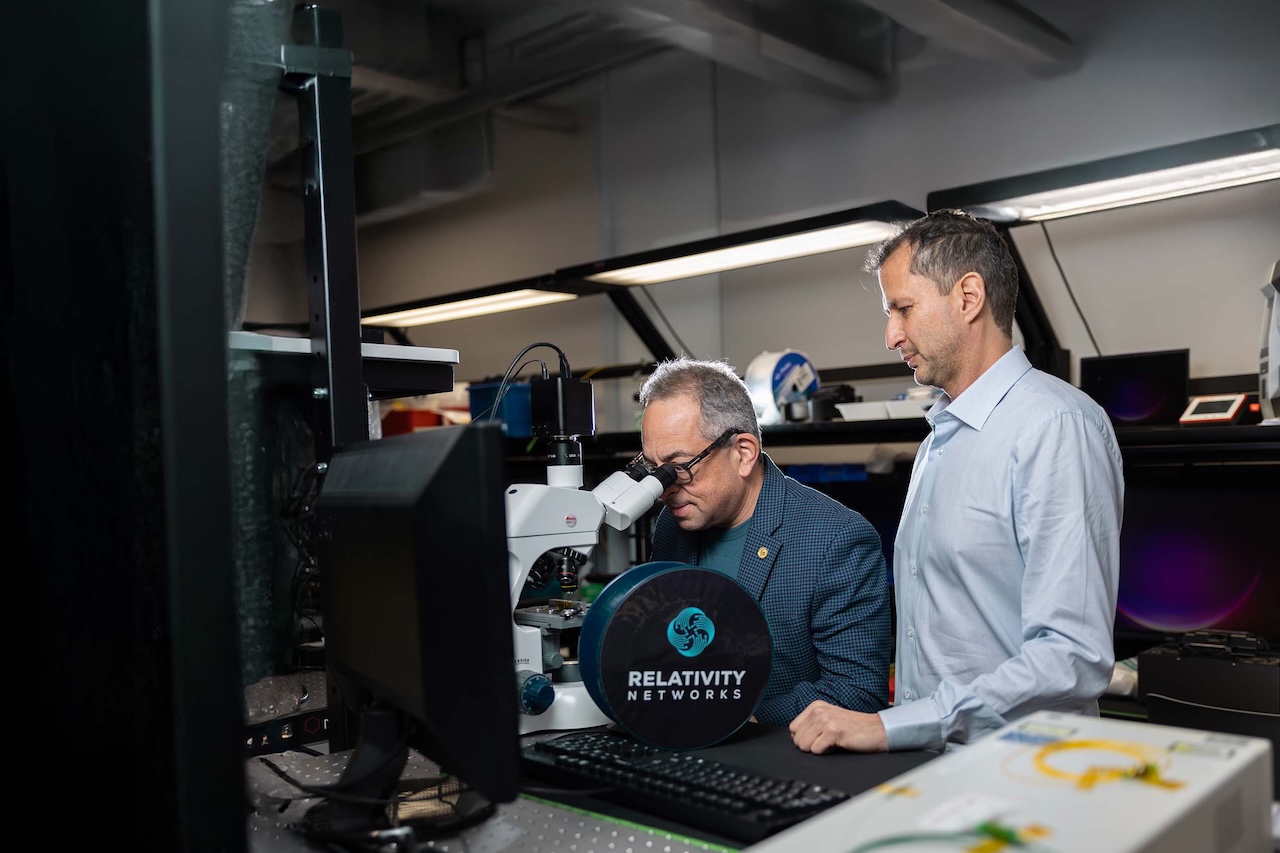
Relativity Networks has secured $4.6 million in pre-seed funding to scale its hollow-core fiber (HCF) technology, addressing the surging demand for high-performance data centers. As artificial intelligence continues to drive unprecedented data processing requirements, Relativity Networks is pioneering solutions to help hyperscalers and cloud providers expand their infrastructure beyond traditional urban locations.
The investment comes as U.S. data centers face an energy crisis, with projections indicating they will consume over twice their current electricity usage by 2026. By 2027, nearly 40% of these facilities could encounter power shortages. Relativity Networks’ fiber-optic technology aims to mitigate this challenge by enabling data centers to operate farther from power-constrained urban hubs while maintaining ultra-low latency performance.
Relativity Networks' patent-pending HCF technology moves data nearly 50% faster than conventional glass fiber, significantly reducing latency and improving connectivity over longer distances. Traditional fiber-optic networks restrict data centers to within 60 kilometers (37 miles) of each other due to latency constraints. However, Relativity’s HCF extends this range to 90 kilometers (56 miles), offering greater flexibility in locating data centers closer to available power sources.
“Currently, new data centers can't be built fast enough to satisfy the rapidly expanding AI-driven economy and the lack of available power is an existential threat to fueling that growth. By moving data faster with lower latency at nearly the speed of light, we are providing the industry new geographic optionality to address the energy-intensive data needs of today's AI-driven digital economy.”
Jason Eichenholz, Founder and CEO of Relativity Networks
The new funding will accelerate the commercialization and deployment of Relativity Networks' HCF technology across major U.S. data hubs. With several multimillion-dollar contracts already secured, the company plans to ramp up production and expand its installation footprint to meet increasing demand.
Beyond infrastructure expansion, Relativity Networks is investing in research and development to further refine its fiber-optic solutions.
The company aims to enable seamless integration with existing network infrastructure while optimizing performance for AI-driven applications requiring ultra-fast data transmission.
Founded in 2023 by Jason Eichenholz and Professor Rodrigo Amezcua, Relativity Networks builds on decades of innovation in optical networking. Eichenholz, a Ph.D. in optical sciences, holds over 90 patents and previously co-founded Luminar, a leader in lidar technology for autonomous vehicles. His deep expertise in photonics and commercialization has positioned Relativity Networks as a key player in next-generation AI infrastructure.
Professor Amezcua, a leading researcher at the University of Central Florida’s College of Optics and Photonics (CREOL), developed the foundational HCF technology that powers Relativity Networks’ solutions. The company benefits from close ties with academic research institutions, ensuring continued advancements in fiber-optic efficiency and performance.
“Hollow core fiber (HCF) represents the next revolution in optical networking, offering unprecedented speeds and lower latency that traditional fiber simply cannot match. This breakthrough demonstrates a decade of dedicated research by our team.”
Dr. Winston Schoenfeld, Vice President for Research and Innovation at UCF
Relativity Networks’ pre-seed funding round was backed by a group of private investors, following an initial investment by Eichenholz. The company’s rapid traction in the market, combined with its strong intellectual property portfolio, has attracted growing interest from strategic partners in the AI and cloud computing sectors.
With AI-driven data demands soaring and power availability becoming a critical constraint, Relativity Networks is well-positioned to redefine the optical network landscape. By leveraging HCF’s advantages in speed and efficiency, the company aims to support the next wave of AI infrastructure expansion while mitigating power challenges in data center deployment.


