Last Updated: 17 June 2026

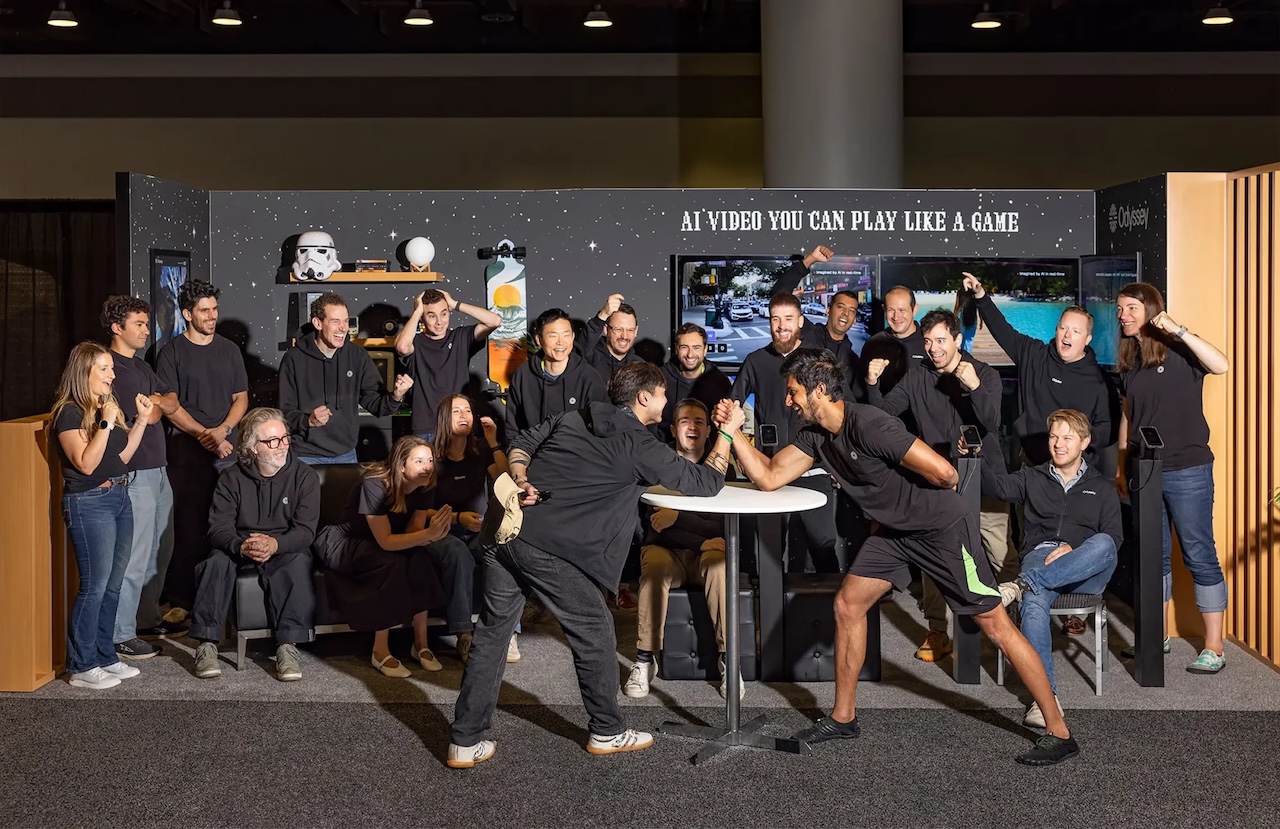
Odyssey, an AI lab building what it calls general world models, has closed a $310 million Series B round. The deal values the company at $1.45 billion. According to the company's own announcement, Odyssey was founded by veterans of the self-driving car industry. A world model works differently from the AI most people already know. Instead of predicting the next word in a sentence, it learns to predict how the physical world behaves, including how objects move, how light falls, and what happens after something is touched or pushed.
This funding round arrives at a moment when AI research is pulling in a new direction. For years, the biggest breakthroughs came from large language models, the technology behind chatbots and writing tools. Now, world models are being framed as the next major frontier beyond text-based AI, largely because they learn directly from the physical world and simulate it using real physics.
Natural Capital led the round. Amazon, AMD Ventures, GV, EQT, and In-Q-Tel also took part. These newer backers join a notable lineup of individual investors, including Jeff Dean, Google's chief scientist, investor Elad Gil, Qasar Younis of Applied Intuition, Garry Tan of Y Combinator, Guillermo Rauch of Vercel, and Kyle Vogt, founder of Cruise. At $1.45 billion, the valuation puts Odyssey among the more highly valued AI companies working outside the large language model space.
A world model tries to do something language models simply cannot. Rather than generating text, it learns to simulate physical environments. It predicts how objects move, how light behaves, and what follows from a given action. Odyssey describes its general world models as causal, multimodal systems built to predict and interact with the world over long stretches of time. In practice, this could look like a robot rehearsing a task inside a simulated kitchen before trying it for real. Or it could mean a researcher testing a scientific idea inside a model of a physical process, well before running it in a lab.
The level of investor interest here suggests something specific. Many in the field now believe world models could become just as foundational to AI as language models have already shown themselves to be. Natural Capital explained that its decision rested on the strength of Odyssey's team, not simply on the appeal of the idea.
"At Natural Capital, we invest behind ambitious technical teams building what comes next. We developed deep conviction in Odyssey's research direction, technical leadership, and execution, which made this our largest investment to date. We believe they have the potential to help define AI beyond language models."
Jay Zaveri, General Partner at Natural Capital
That kind of confidence matters in a field where much of the underlying technology is still being worked out. Investors appear willing to bridge the gap between today's research and tomorrow's real-world use. They are betting that a team shaped by early breakthroughs in self-driving cars can repeat that pattern with world simulation.
The new money is going toward two related goals. The first is scaling up computing power. The second is pushing Odyssey's research closer to real-world use. Alongside the funding, Odyssey announced a separate agreement with Amazon Web Services, which will now serve as its preferred cloud provider. The company plans to use AWS Trainium chips, a type of processor built specifically for AI workloads, alongside the other hardware already running its systems. Odyssey and AWS also intend to work together on research, and on bringing world model technology to more customers.
"World models represent one of the most demanding workloads in AI—they require massive compute throughput with tight latency constraints. Odyssey's team has been pushing the boundaries of what's possible in this space, and Trainium is purpose-built for exactly this kind of scale."
Ron Diamant, Vice President and Distinguished Engineer at Amazon
Beyond infrastructure, Odyssey plans to keep building on its existing research rather than shift direction. Oliver Cameron, the company's Co-Founder and CEO, has compared this moment in the field to the breakthrough that turned language models from a research project into something widely used.
"We believe world models represent a new class of foundation model—AI that can understand and simulate the world itself. The last few years have seen major breakthroughs in scaling, interactivity, multimodality, and physics accuracy, and the field is now advancing extremely quickly. This round provides the compute, infrastructure, and partners to push the frontier of general world models, and to achieve a GPT-3 moment for the field."
Oliver Cameron, Co-Founder and CEO of Odyssey
According to the company's funding announcement, Odyssey is led by Oliver Cameron, its Co-Founder and CEO. The company describes itself as founded by veterans of the self-driving car industry, a background that gave its founders direct, hands on experience with the challenge of building machines that can interpret and predict physical environments in real time. That experience appears to have shaped a larger ambition. Rather than build another driving system, Odyssey chose to generalize the underlying idea: simulating the physical world itself.
The company has built a research team drawn from well known names across AI, including DeepMind, Tesla, Waymo, Meta, Apple, and Wayve. Members of that team previously worked on projects such as Google DeepMind's Gemini language model, its Veo video model, Wayve's GAIA world model, and Tesla's self-driving software. Rather than release one flagship product, Odyssey has shipped a series of research projects. Odyssey-2 Max focused on improving the physical accuracy of world simulations. Starchild-1 introduced real-time multimodal interaction. Agora-1 let multiple users or AI agents share the same simulated environment. PROWL explored how a world model can improve itself through active exploration instead of passive observation.
According to its own materials, what distinguishes Odyssey is the range of its ambition. The company states that it hopes its technology can eventually support robotics, science, healthcare, education, gaming, and defense, treating world simulation as a general capability rather than a tool built for one industry alone.
The Series B brought together a mix of institutional and strategic backers. Natural Capital led the round, marking its largest investment to date. Amazon, AMD Ventures, GV, EQT, and In-Q-Tel each joined as participants. The presence of Amazon and AMD Ventures stands out, since both companies make the kind of specialized chips that world models rely on. That detail suggests the investment carries a strategic angle beyond simple financial return.
These newer backers join a group of individual investors who supported Odyssey earlier on, including Jeff Dean, Elad Gil, Qasar Younis, Garry Tan, Guillermo Rauch, and Kyle Vogt. With this round, Odyssey has raised $310 million in this Series B alone, placing it among the better funded research labs working outside the large language model space. The size of the round reflects a broader pattern: capital is moving quickly toward world model research, as investors try to figure out which lab might come to define the category.


