Last Updated: 19 April 2025


AI is transforming industries and society, and behind this transformation are visionary people driving research, innovation, and policy. At Just AI News, we decided present our list of top artificial intelligence leaders primarily associated with U.S.-based companies or institutions. These individuals – tech executives, startup founders, renowned researchers, and public officials – have each had a long-term impact on how AI is developed and applied.
Our list spans those building technologies in the private sector to thought leaders in academia and government who shape AI strategy and ethics.
Top pick these AI leaders, we focus on their contributions and philosophies rather than buzzwords. These are the people influencing the AI systems we interact with daily, from the algorithms in our smartphones to the policies that govern AI’s use.
All are connected to U.S. companies or institutions (regardless of their personal nationality), reflecting the prominent role of the United States in the AI ecosystem. By understanding their work, we gain insight into the future of artificial intelligence – a future they are actively shaping in ways large and small.
Sundar Pichai, CEO of Alphabet, has played a central role in making AI a core part of Google’s products — from search and translation to voice assistants and smartphone features used by billions of people. Under his leadership, Google became what he calls an “AI-first” company, investing heavily in research and bringing AI into everyday tools in a way that feels almost invisible but makes a real difference.
He also brought together Google’s top research teams to form Google DeepMind, aiming to move faster toward more advanced AI. But while he’s clearly focused on pushing the technology forward, Pichai has also been one of the more thoughtful voices around its risks.
He is known for his calm, inclusive leadership style and for steering Google to invest deeply in AI research, while bringing AI advances like voice assistants and language translation to billions of users.
Back in 2018, he helped introduce Google’s AI principles — a public commitment to build AI responsibly. He’s said more than once that AI is too important not to regulate, and that we need smart, balanced rules to make sure it’s used safely.
By advising governments and committing Google to ethical standards, Pichai exemplifies the tech executive who not only builds transformative technologies but also considers their broader societal impact.

CEO of Microsoft since 2014, he has placed AI at the heart of the company’s direction. Under his leadership, Microsoft partnered closely with OpenAI and began adding AI features across its products — from Office and Windows to Azure’s cloud tools. The idea? Make AI something useful that people can actually rely on in their day-to-day work.
Nadella often talks about AI as a “co-pilot” — not something that replaces people, but something that helps them work smarter. Tools like GitHub Copilot or Microsoft 365 Copilot are built around that idea, assisting with everything from writing emails to coding.
He’s also known for taking a thoughtful approach. At the World Economic Forum, he said we’re entering a “golden age” of AI — but only if it’s guided with care.
Nadella believes the tech is powerful, but so are the choices around how it’s used. For him, it’s not just about building smarter systems — it’s about building them responsibly, with safety and people in mind.

Sam Altman is the CEO of OpenAI and one of the most visible figures in today’s AI conversation. A former president of startup accelerator Y Combinator, he brought a fast-moving, product-focused mindset to OpenAI — helping turn research into widely used tools like GPT-3, DALL·E, and ChatGPT. These AI platforms have introduced millions of people to what AI can actually do, from writing code to generating images or answering complex questions.
But Altman isn’t just focused on building powerful AI — he’s also one of the loudest voices calling for smart regulation. He’s said that AI has the potential to help billions of people, but only if it’s developed and used safely. In 2023, he spoke in front of the U.S. Congress, urging lawmakers to create clear rules for advanced AI systems.
That mix — pushing the tech forward while asking serious questions about how it’s used — is what defines his leadership style. Altman is not just building the future of AI; he’s also helping shape the public conversation around how it should be handled.
Co-founder of DeepMind and now CEO of Google DeepMind, Demis is a former child chess prodigy with a PhD in cognitive neuroscience, he has long envisioned building artificial general intelligence (AGI) — AI that can learn and think like humans — and using it to tackle some of the world’s toughest problems.
He’s behind some of the most widely recognized breakthroughs in AI — including AlphaGo, which beat a world champion at Go, and AlphaFold, which made major progress in understanding how proteins fold. These projects showed that AI could do much more than power apps — it could help scientists make real progress.
At the same time, Hassabis takes a cautious approach. He often talks about the need for clear rules and ethical boundaries, especially as AI systems become more powerful. He’s even slowed the release of some tools to ensure they’re safe.
For him, it’s not just about what AI can do — it’s about making sure it’s used in ways that genuinely help people.

Jensen Huang, co-founder and CEO of NVIDIA, has become one of the most recognizable figures in the AI world — and for good reason. His work has played a huge role in powering the AI systems we rely on today. NVIDIA’s graphics chips, originally built for gaming, turned out to be perfect for training modern AI models — and Huang saw that potential early. Over the past decade, he’s steered the company to become the top provider of AI hardware.
Today, the vast majority of advanced AI models are trained on NVIDIA GPUs – analysts estimate the company controls between 70% and 95% of the market for AI model accelerators. In practical terms, that means everything from ChatGPT to self-driving car systems rely on NVIDIA chips. Huang’s strategic bets on specialized AI chips and software enabled the deep learning revolution by providing the necessary computing power.
He’s known for his bold vision, signature black leather jacket, and high-energy presentations. Huang often talks about AI as the driving force behind a new era of computing — and he’s made sure NVIDIA is right at the center of it.
From cloud computing to robotics and autonomous vehicles, his influence goes well beyond chips. Simply put, he built the infrastructure many others now rely on to develop AI.

Mark Zuckerberg, the co-founder and CEO of Meta, is best known for social networking, but he has increasingly become a major player in AI. Meta runs one of the largest AI research labs in the world and has developed AI systems that underpin content recommendation, translation, and more for Facebook, Instagram, and WhatsApp.
In recent years, Zuckerberg has championed an open-source approach to AI. In 2023 Meta released LLaMA and LLaMA 2, advanced large language models, freely to researchers and developers. This was a divergent strategy from competitors who kept their models proprietary.
Zuckerberg argued that “open-source will ensure that more people around the world have access to the benefits and opportunities of AI, that power isn’t concentrated in the hands of a small number of companies, and that the technology can be deployed more evenly and safely across society”. In his view, sharing AI models widely can spur innovation and help catch errors, making AI better for everyone.
This philosophy aligns with his broader narrative of democratizing technology. It has won him praise from many developers and academics who see Meta’s open models as a “democratizing force in AI development”.
He considers AI and the metaverse as twin pillars of Meta’s future. By fully embracing AI and pushing for openness, Mark Zuckerberg has intensified industry competition and positioned Meta as a key influencer in how AI evolves – not just within one company, but across the global tech community.

Elon Musk is a billionaire entrepreneur known for Tesla electric cars and SpaceX rockets, but he has also played an influential, and sometimes controversial, role in AI.
He was one of the original co-founders of OpenAI in 2015, driven by concerns about the risks of unchecked artificial intelligence. After stepping away from OpenAI, he launched a new company in 2023 called xAI, with the bold goal of using AI to “understand the true nature of the universe.”
Musk’s companies already rely heavily on AI. Tesla uses it for autonomous driving, and SpaceX applies it in robotics and navigation. Projects like Neuralink and humanoid robots from Tesla show how far he’s willing to go in pushing AI into new areas.
At the same time, Musk has been one of the loudest voices warning that AI could eventually pose serious risks to humanity.
He’s called for tighter regulation and even supported the idea of slowing down development of powerful AI systems until safety measures are in place. His views are often controversial — but they’ve helped bring AI ethics and governance into the spotlight.
Andrew Ng is one of the foremost educators and evangelists in the AI field, known for making AI knowledge accessible. He co-founded Google Brain back in 2011, helping show the world what deep learning could do. Later, as Chief Scientist at Baidu, he led major AI efforts in industry — but it’s through education that he’s had the broadest impact.
In 2012, Ng co-founded Coursera, where his online machine learning course reached millions of learners globally. He later launched deeplearning.ai, offering practical training programs for people looking to enter the field. His clear, down-to-earth style has helped train an entire generation of AI engineers.
Ng often says, “AI is the new electricity” meaning it’s going to touch every industry, just like electricity did a century ago. He doesn’t focus on sci-fi risks — he’s more interested in how AI can make real-life work easier, more efficient, and more human-centered.
Through teaching, writing, and hands-on projects, Andrew Ng has become the face of AI education, empowering countless people and companies to harness AI’s power in a human-friendly way.
Yann LeCun, Chief AI Scientist at Meta and professor at NYU, has been one of the most important voices in AI for decades. He pioneered convolutional neural networks (CNNs) — a technique that helped make image recognition practical and scalable. That work became a building block of modern AI and earned him the 2018 Turing Award, alongside Geoffrey Hinton and Yoshua Bengio.
Today, LeCun plays a central role in steering Meta’s AI research and continues to publish widely. He’s known not just for his technical leadership, but also for speaking out about where AI is — and where it isn’t. He often critiques exaggerated claims about AI risk and prefers to focus on problems we can solve now.
By bridging deep research and real-world impact, LeCun remains one of the field’s most respected and influential thinkers.

Fei-Fei Li has spent her career working at the intersection of AI and humanity. A professor at Stanford University and co-director of its Human-Centered AI Institute, she’s known for leading research that prioritizes the people who will use — and be affected by — AI.
She played a pivotal role in modern computer vision by leading the development of ImageNet, a dataset that helped AI systems recognize and categorize images. That work became the foundation for much of today’s deep learning progress. She also brought her research into industry during her time as a VP at Google Cloud, where she focused on making AI tools useful in the real world.
Li is also a passionate educator and advocate. She’s worked to expand diversity in STEM and regularly raises awareness of issues like bias, privacy, and job displacement in AI. Her goal has always been clear: to build AI that complements human life — not replaces it.
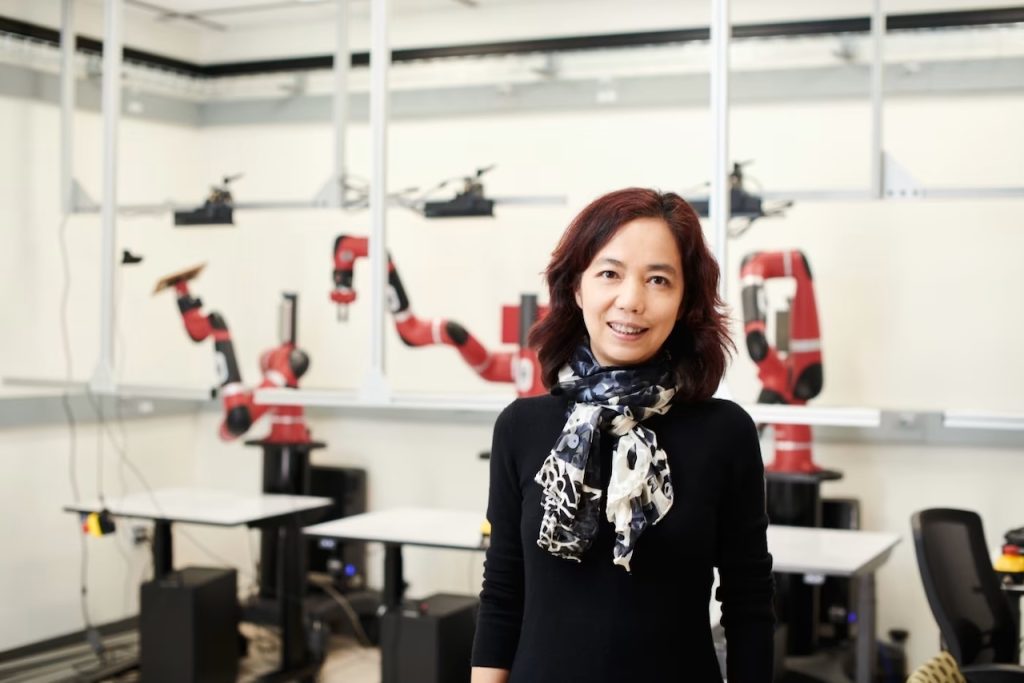
Ilya Sutskever is a respected AI researcher and now Co-Founder and Chief Scientist at Safe Superintelligence Inc., a new company focused entirely on building safe and powerful AI systems. Before this, he was one of the original co-founders of OpenAI, where he played a central role in creating the GPT models behind ChatGPT, as well as other projects like DALL·E.
His background is deeply rooted in research — he worked closely with Geoffrey Hinton as a student and helped develop AlexNet, the deep learning model that brought new attention to neural networks.
What sets Sutskever apart is his strong technical instinct and his honest view of how complex AI systems really are. He once described training a large AI model as “building a process that builds the thing,” showing how much there still is to learn about how these systems work. That curiosity drives his work on both new AI models and research into safety. With experience at both Google and OpenAI, Sutskever has been behind many of today’s most widely used AI tools — combining deep research with real-world impact.
Ilya is both a scientist and an engineer, giving him a unique ability to turn AI theories into practical technologies. He's been central to major AI advancements at both Google and OpenAI, making him one of today's most influential figures in AI.
Mira Murati was the Chief Technology Officer at OpenAI between 2022 and 2023. She was a key figure behind the development of tools like ChatGPT, DALL·E, and GPT-4. With a background in both engineering and product development — including work at Tesla and Leap Motion — she brings a rare blend of technical depth and real-world perspective to one of the most influential AI labs in the world.
At OpenAI, she led teams across research and engineering, helping turn complex models into usable tools. What sets Murati apart is her clarity when discussing AI’s risks. She’s been one of the few public tech leaders to consistently call for regulation and external oversight — even as excitement around generative AI continues to grow.
Her approach balances optimism with realism. She believes AI can support meaningful progress in fields like education and healthcare, but only if it’s introduced thoughtfully.
As one of the most visible women in the field, Murati is not just shaping AI products — she’s helping guide the broader conversation on how this technology should evolve.
Dr. Geoffrey Hinton is often called the “Godfather of Deep Learning” for his foundational role in the AI breakthroughs of the past decade. An emeritus professor at the University of Toronto, Hinton has been researching neural networks since the 1980s – often persevering when the field went out of fashion.
His persistence paid off: in 2012, Hinton and his students created a neural network that dramatically improved computer vision accuracy (the famous “AlexNet” result), kicking off the deep learning revolution.
Hinton later joined Google Brain and helped integrate deep learning into Google’s services like speech recognition and search. In 2018, he received the Turing Award alongside LeCun and Bengio for deep learning’s development.
Daphne Koller is a computer scientist and entrepreneur known for turning AI research into real-world impact. As a Stanford professor, she helped shape the field of machine learning and co-founded Coursera in 2012, bringing free online courses — including her own — to millions of students around the world. This opened the door for many to learn about AI for the first time.
Later, Koller founded Insitro, where she now serves as CEO, using AI to speed up drug discovery and develop more targeted treatments.
She often highlights the importance of combining biology and AI, and is widely respected for promoting collaboration across fields. From education to healthcare, Koller’s work shows how AI can serve people — not just power technology.
Jeff Dean is one of Google’s most influential engineers and a driving force behind the AI systems we use every day. He co-created core infrastructure like TensorFlow and helped launch Google Brain, proving that neural networks could scale to massive datasets. His work laid the foundation for major AI advances, including the Transformer architecture behind models like ChatGPT and BERT, which improved Google Search.
Now serving as Google’s Chief Scientist, Dean sets the direction for the company’s most ambitious AI research, from multimodal models to fairness and transparency. Known for mentoring teams and staying close to the code, he blends deep technical skill with a commitment to responsible AI.
Simply put, Jeff Dean helped build the backbone of today’s AI — and he’s still shaping where it goes next.

As artificial intelligence continues to transform the future of work, science, and society, it’s worth remembering that behind every innovation are people making critical choices — about what to build, who benefits, and how risks are managed.
The AI leaders featured in this article don’t just reflect where artificial intelligence is today; they’re actively deciding where it goes next.


